
 English
 한국어
 Français
 Español


Forklift Non-Marking Tires: A Practical Guide to Choosing the Right Compound
Ask a warehouse supervisor where the black scuff marks along the aisle come from and you will usually get a shrug, then a guess. Most of the time the answer is sitting right under the truck: a standard black rubber tire quietly laying down a trail every time the machine turns, brakes or lifts a load. That is exactly why forklift non-marking tires exist, and why they have become standard equipment in far more facilities than people expect.
We build and supply industrial tires for forklifts, aerial platforms and other handling equipment, and the questions we hear about non-marking compounds are remarkably consistent. Do they actually work? Do they wear out faster? Are they worth the extra cost? Below is our honest, practical answer, drawn from what we see on customer floors rather than from a brochure.
Content
What “Non-Marking” Really Refers To
Standard industrial tires owe their color and much of their abrasion resistance to carbon black. It is an excellent reinforcing filler, but it is also the reason a hard turn leaves a grey-black smear on a polished floor. Non-marking compounds replace most or all of that carbon black with light-colored reinforcing fillers such as precipitated silica, treated clay or titanium-based systems. The rubber stays tough enough to carry load, yet it leaves little or no carbon residue behind.
Here is the point most buyers get wrong: color is a side effect, not the definition. Some non-marking tires are pale grey, some are almost white, and plenty are a dark charcoal that looks black at a glance. You cannot judge a tire by its shade in a photograph; you judge it by its compound formulation and by what it leaves on the floor after a week of real work.
There are honest trade-offs. Non-marking compounds generally run a little softer and build heat faster, so cut-and-chip resistance against sharp debris can be lower than a top-tier black compound. Quality varies enormously across the market, which is why cheap non-marking tires sometimes chunk and crack long before their tread is worn. We have written a short companion piece on the main benefit of solid non-marking tires if you want the floor-protection argument in more detail.
Where Non-Marking Tires Pay for Themselves
Non-marking rubber is not a luxury upgrade for every site. It earns its price in specific environments where a mark on the floor is more than a cosmetic problem:
- Food and beverage plants. Black rubber dust is a foreign-body risk, and most audit programs treat it as contamination rather than dirt.
- Pharmaceutical and medical facilities. Cleanroom discipline extends to the equipment moving through it.
- Electronics and precision assembly. Sealed epoxy floors are inspected daily, and scuffs are read as housekeeping failures.
- Distribution centers with coated or polished concrete. Marks accumulate in high-traffic aisles and become a slip-risk conversation.
- Retail, showroom and public-facing areas. A forklift that leaves a trail across a customer floor is a complaint waiting to happen.
- Cold storage and airport ground handling. Where floors stay damp, transferred rubber turns into a genuine traction concern.
If your trucks never leave rough concrete or an outdoor yard, standard black tires will usually give you more wear for the money. The calculation changes the moment appearance, hygiene or floor safety matters.
Choosing the Right Compound and Tread for Your Floor
Selection starts with the floor, not with the tire catalogue. Sealed, smooth indoor concrete wants a smooth non-marking tread with a harder compound that resists scrubbing during tight turns. Mixed routes, dock plates and the occasional trip across packed gravel call for a traction or lug pattern, because a smooth tire will spin and flat-spot the moment it loses grip.
Load, duty cycle and heat
A three-shift operation running at rated capacity generates far more internal heat than a single-shift warehouse. Heat is what kills industrial tires early, so heavy duty cycles justify a harder compound and a deeper tread, even if the initial price is higher. Check the load rating against the actual axle load your truck carries, including the attachment and the heaviest pallet you realistically move - not the brochure figure.
For conventional counterbalance trucks working standard warehouse aisles, our
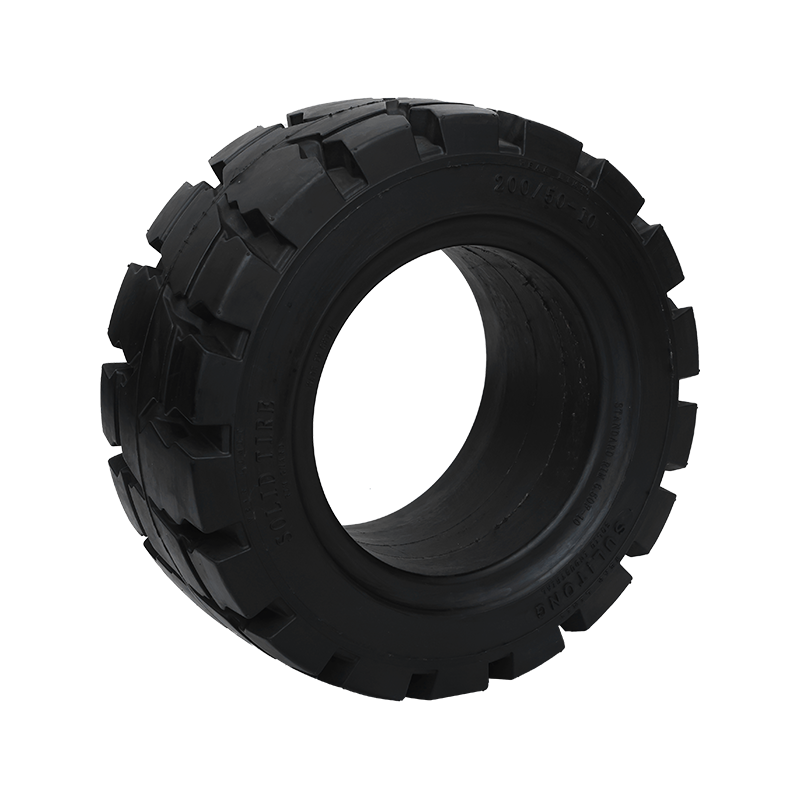 Solid Forklift Tires for Conventional Counterbalance TrucksThree-layer solid rubber tires with wear-resistant tread and steel-wire base, suited to standard-aisle counterbalance trucks needing durability, stability and operator comfort.View Product →
For smaller electric machines in narrow-aisle picking and light indoor transport,
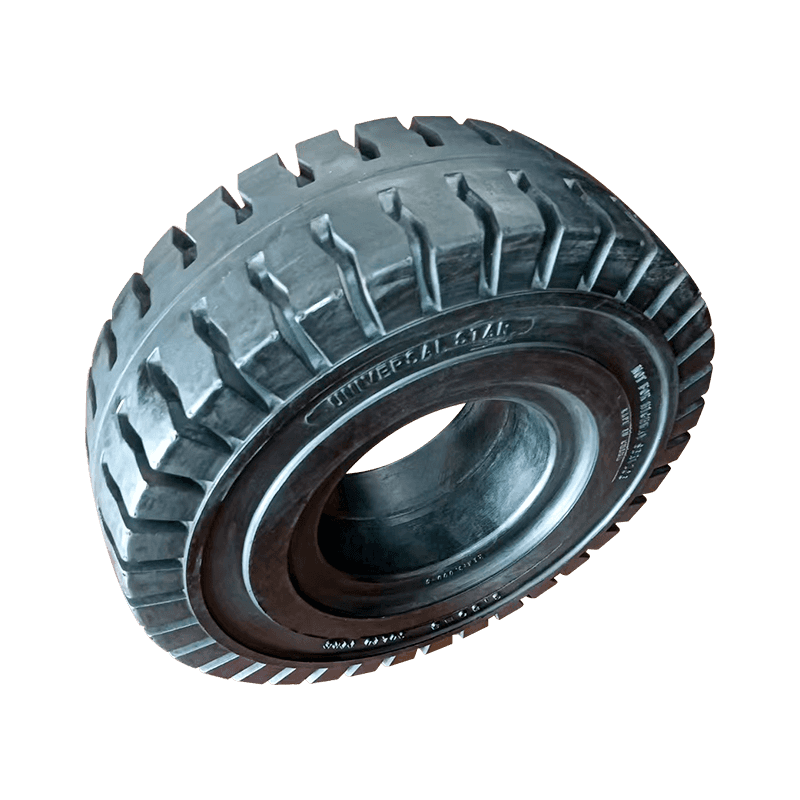 Solid Run-Flat Tires for Electric Mini ForkliftsMaintenance-free solid run-flat tires bonded to steel rims, offered in 18 sizes for electric mini forklifts in warehouses and light indoor transport.View Product →
Both categories share the same rule: match the tire to the machine's real duty, not to the biggest number in the specification sheet.
Comparing the Common Options
Most fleets end up choosing between four basic configurations. The table below sets out how they behave in practice.
| Tire option | Effect on floors | Grip on wet or uneven ground | Best fit |
|---|---|---|---|
| Non-marking smooth, press-on solid | No carbon residue, minimal dust transfer | Limited; avoid wet ramps | Sealed indoor floors, food, pharma, retail |
| Non-marking traction or lug | Still leaves no black marks, slightly more contact noise | Good on dock plates and packed yards | Mixed indoor and outdoor routes |
| Standard black smooth | Leaves scuffs and black dust | Limited indoors, poor outside | Unfinished concrete where appearance is irrelevant |
| Pneumatic black | Marks floors and tracks mud inside | Strong on rough ground | Construction yards and gravel |
Fit, Size and Mounting Details That Matter
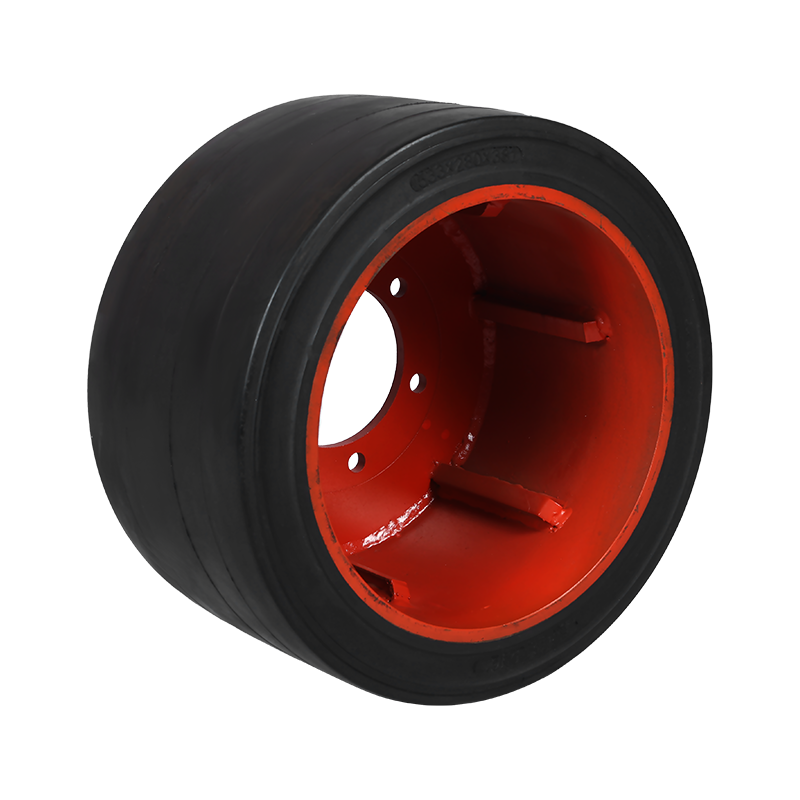
Press-on solid tires rely on an interference fit: the tire's inner diameter is deliberately smaller than the rim, and it is pressed on cold with proper equipment. Mount a tire on a rim that is already worn, out of round or rusty and you will get slippage, uneven wear and heat build-up no compound can survive. Measure the rim before every change, not just the first one.
Where a full press-on range is needed across mixed fleets and multiple rim sizes, our
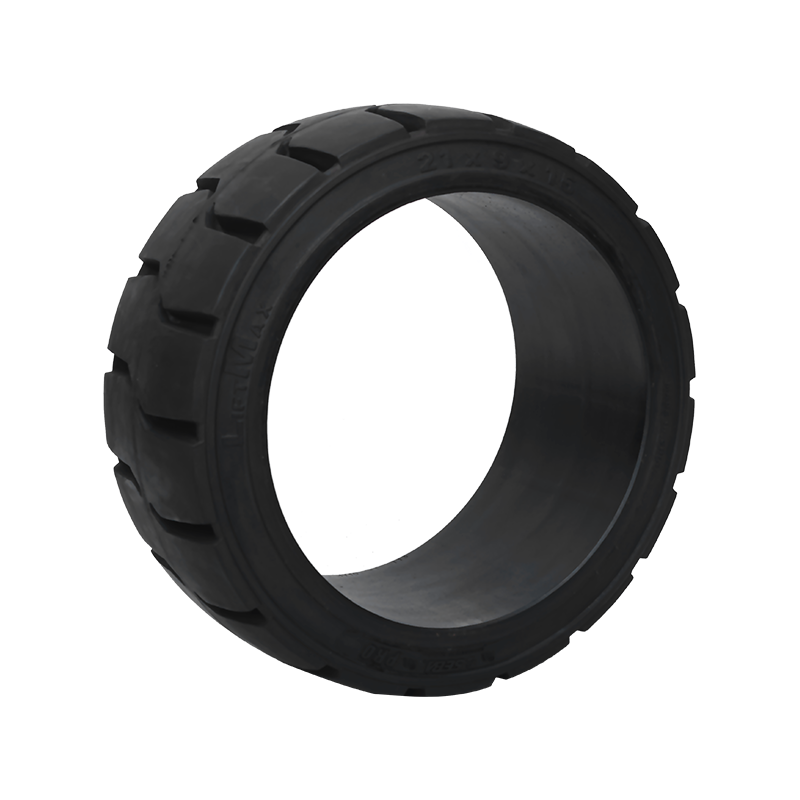 Press-On Solid Tyres for Mixed Fleets and Rim SizesSteel-rim press-fit solid rubber tyres with low rolling resistance and wear-resistant tread, available in a broad size range for forklifts, trailers and industrial vehicles.View Product →
Two more practical points. Replace tires in matched pairs on the same axle so braking and steering stay even, and confirm that the outside diameter you are fitting still matches the truck's original specification - a small difference in rolling radius can affect speed sensors, odometers and, on some electric models, the motor's heat load.
Getting Long Life Out of a Non-Marking Tire
Non-marking compounds are not fragile, but they are less forgiving of neglect than black rubber. The fleets that get full life from them tend to follow the same habits:
- Rotate tires between positions on a fixed schedule so wear stays even across the fleet.
- Keep axle loads inside the rating; overload is the fastest route to sidewall heat and flat spotting.
- Clear grit and metal scrap from aisles - soft compounds cut more readily than hard black ones.
- Inspect monthly for chunking, cracking and shoulder wear, and act on the first sign rather than the third.
- Store spare tires out of direct sunlight and away from solvents, oils and ozone sources such as electric motors.
- Track hours and load rather than calendar age when planning replacements.
Do this consistently and the cost-per-hour gap between a good non-marking tire and a standard black one narrows considerably, while the floor stays clean the whole time.
Bringing It Down to Your Own Operation
Non-marking forklift tires are not complicated, but they are easy to buy badly. The specification that matters is a combination of compound hardness, tread pattern, load rating and rim condition, all matched to the floor your truck actually drives on and the hours it actually works. Get those four right and the marks disappear, the dust drops and the tires wear the way they should.
If you are weighing up a change and want a second opinion on compound or sizing for your fleet, send us the details of your trucks and floors and we will point you at the option that fits, rather than the one that happens to be in stock.
CONTACT US
-

Email: SMT001@saimeite-tyre.com
-

Phone: +86-18451337018No. 1, Renmin South Road, Yandu District, Yancheng City, Jiangsu Province, China