
 English
 한국어
한국어 Français
 Español

Aerial Work Solid Tires: What They Are, Why They Matter, and How to Choose the Right One
Content
- 1 Why Aerial Work Platforms Need Solid Tires
- 2 How Aerial Work Solid Tires Are Constructed
- 3 Reading Aerial Work Solid Tire Specifications
- 4 Matching Solid Tire Compound to the Job Site Surface
- 5 Comparing Solid Tires to Pneumatic Tires on Aerial Work Platforms
- 6 How to Identify When Aerial Work Solid Tires Need Replacing
- 7 Buying Aerial Work Solid Tires: What to Look For in a Supplier
- 8 Solid Tire Installation on Aerial Work Platforms: Getting It Right
Why Aerial Work Platforms Need Solid Tires
Aerial work platforms — scissor lifts, boom lifts, telehandlers, and vertical mast climbers — operate in some of the most demanding tire environments imaginable. They carry heavy loads elevated high off the ground, maneuver across construction sites littered with sharp debris, navigate warehouse floors coated in oil and metal swarf, and sometimes sit stationary under load for extended periods on uneven surfaces. In these conditions, a conventional pneumatic tire is a liability. A single puncture on an elevated platform is not merely an inconvenience — it is a stability risk that can compromise the entire machine and endanger the operator and anyone working nearby.
Aerial work solid tires eliminate that risk entirely. Because they contain no air cavity, there is nothing to puncture, nothing to go flat, and no pressure to monitor or maintain. The load is carried by the tire's rubber compound and internal structure rather than by compressed air, delivering a consistent ride height and footprint regardless of what the tire runs over. For fleet managers, rental companies, and site supervisors responsible for keeping aerial work platforms operating safely and productively, solid tires for aerial work platforms are not simply an alternative to pneumatics — they are in most applications the correct and only sensible choice.
Understanding what distinguishes a well-engineered aerial work platform solid tire from an inferior one, how to read the specifications that matter, and how to match tire characteristics to the specific demands of each machine and job site is essential knowledge for anyone making tire purchasing decisions on aerial equipment. The cost of getting it wrong — in terms of machine downtime, premature tire failure, floor damage claims, and in worst cases, stability incidents — far exceeds the cost of the tires themselves.
How Aerial Work Solid Tires Are Constructed
Not all solid tires are built the same way, and the construction method has a direct bearing on how the tire performs under the specific load cycles, surface conditions, and operational demands of aerial work equipment. There are three principal construction types used in the aerial work platform solid tire market, each with a distinct performance profile.
Press-On Solid Tires
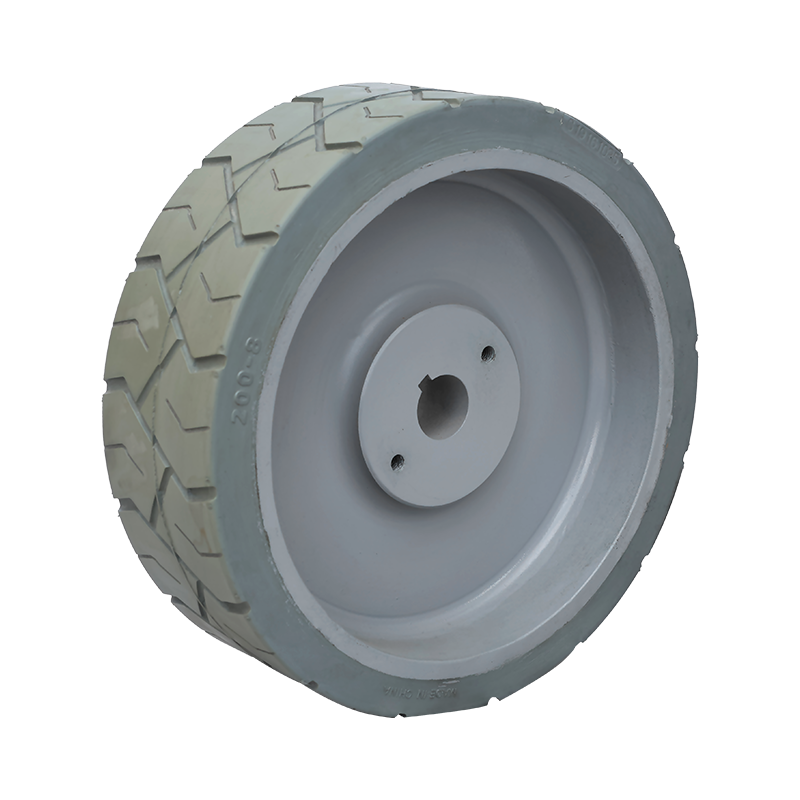
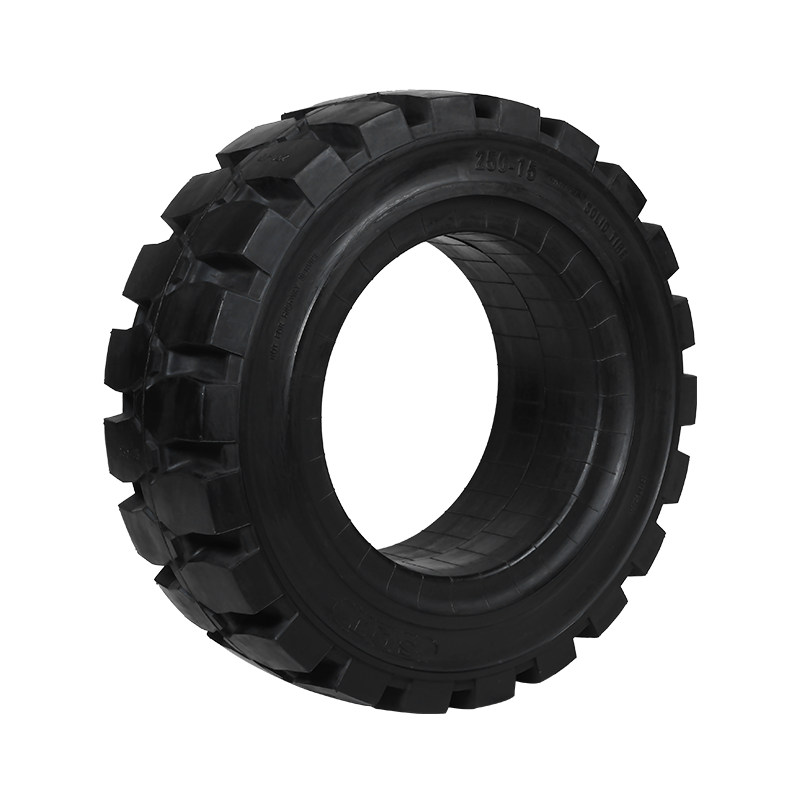
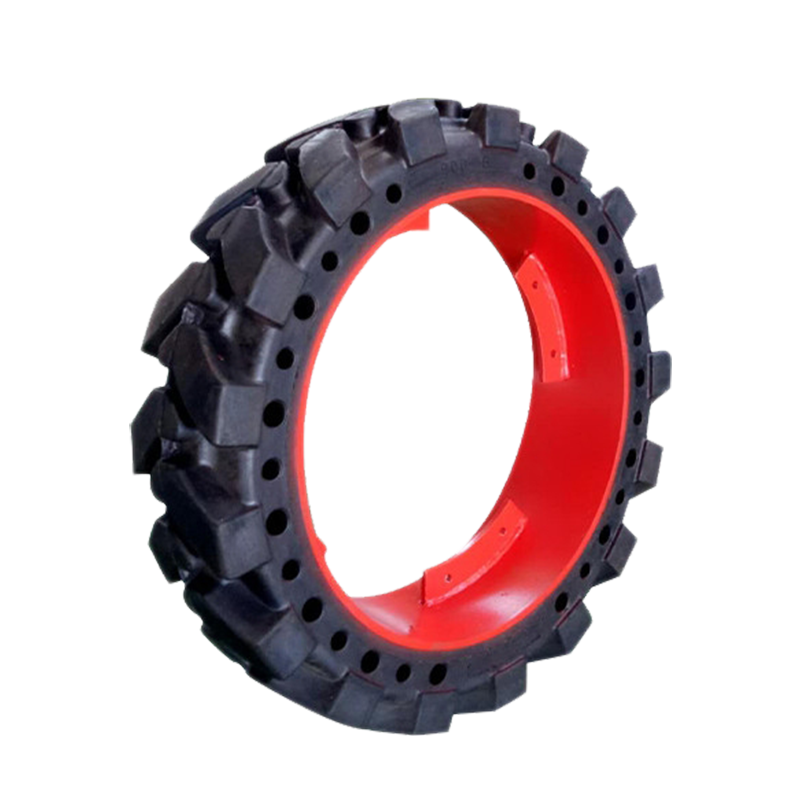
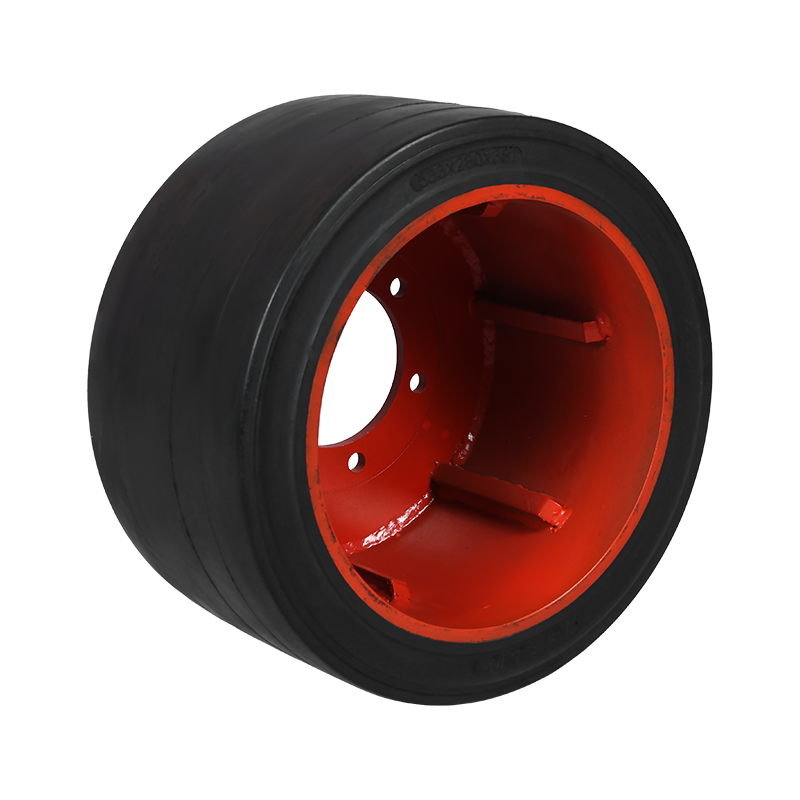
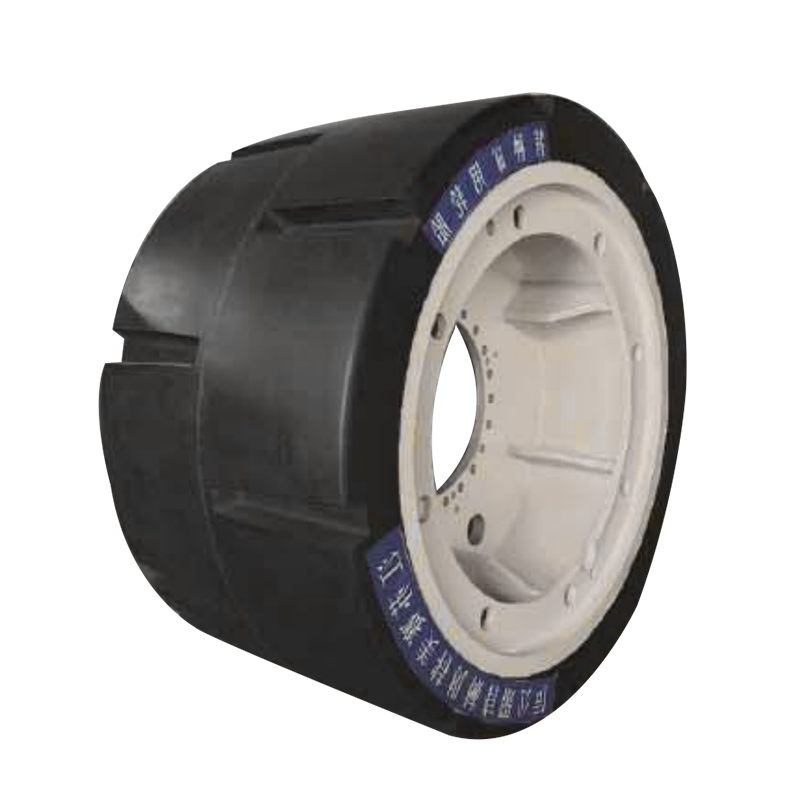
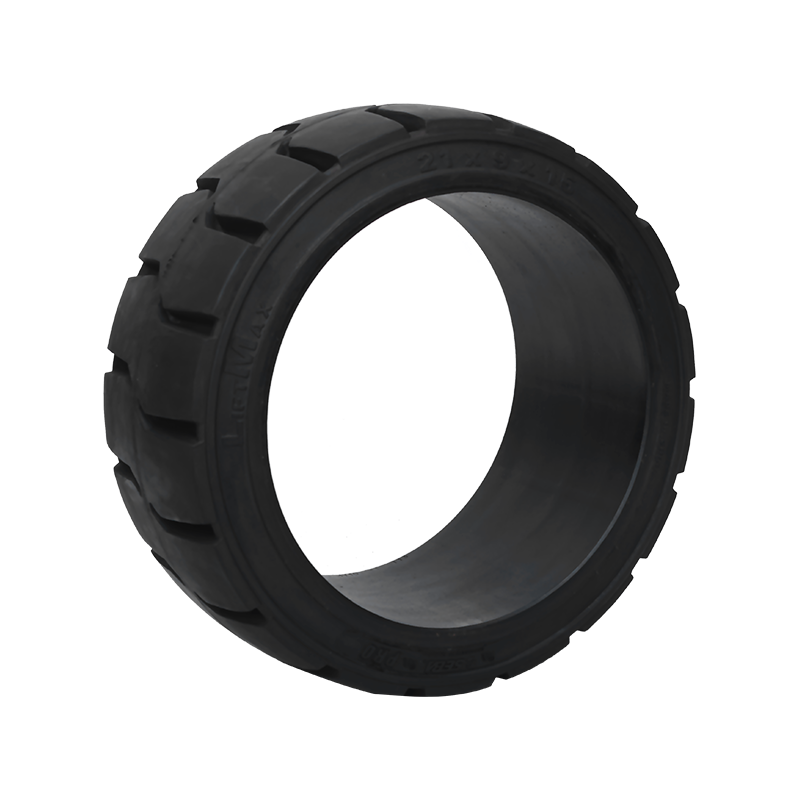
Press-on solid tires — also called solid rubber tires or band tires — consist of a solid rubber molding that is pressed directly onto a steel wheel rim using a hydraulic press. The tire has no bead wire or internal structure; it is a single-piece rubber component shaped to match the rim's retaining groove. Once pressed on under sufficient force, the interference fit between the rubber and the rim provides secure retention under normal operating loads. Press-on solid tires are the most widely used tire type on electric scissor lifts and compact vertical mast platforms operating on smooth indoor surfaces. They are lightweight, low-cost to manufacture, and available in a very wide range of sizes to suit virtually every scissor lift model on the market.
The performance limitation of press-on solid tires is their hardness. Because the entire load must be absorbed by the rubber compound without any pneumatic cushioning effect, press-on tires transmit more vibration to the machine and platform than foam-filled or cushion solid options. On smooth warehouse concrete this is acceptable. On rough outdoor surfaces — asphalt expansion joints, aggregate-surfaced yards, or uneven concrete — the vibration transmitted through hard press-on tires increases operator fatigue and can stress machine structure over time. For outdoor or rough-surface applications, softer compound or alternative construction types are preferable.
Cushion Solid Tires
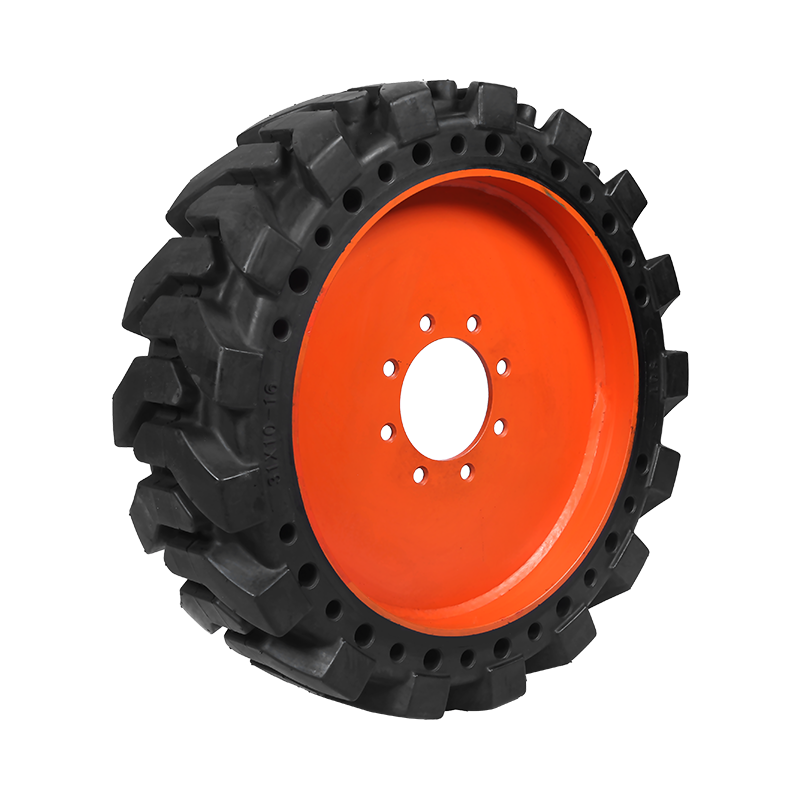
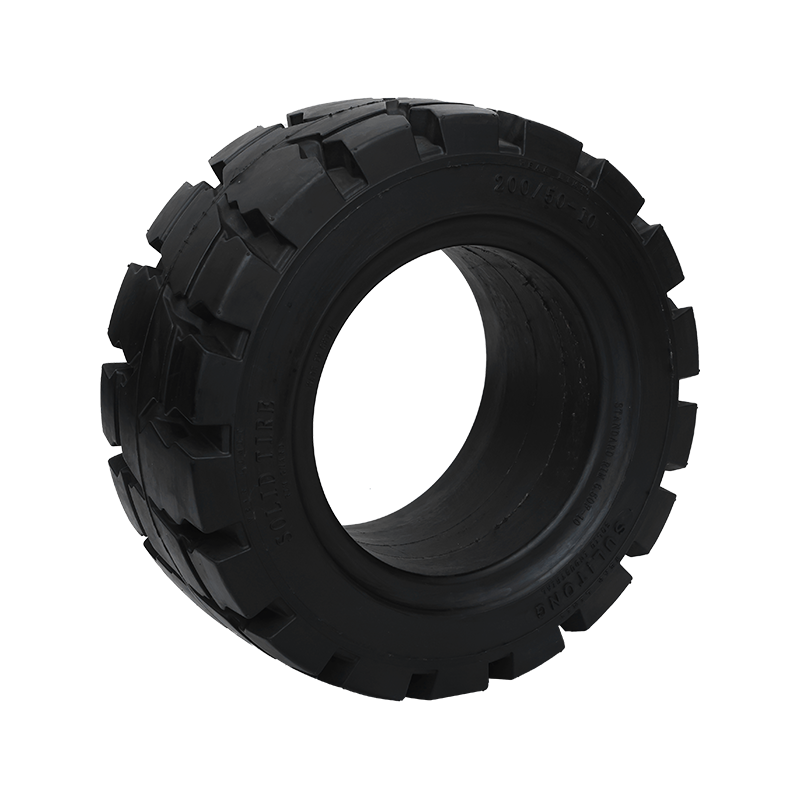
Cushion solid tires use a multi-layer rubber construction — typically a harder base layer bonded to a softer outer tread layer — to deliver a compromise between the puncture-proof reliability of solid rubber and the ride comfort of a pneumatic. The softer outer compound deforms slightly under load, absorbing surface irregularities and reducing vibration transmission to the platform. The harder inner layer maintains load-carrying capacity and prevents excessive deflection that would cause the tire to overheat or roll off the rim under cornering loads. Cushion solid tires for aerial work platforms are specified for applications where the machine operates on moderately uneven surfaces — outdoor construction sites with compacted gravel, semi-finished concrete, or asphalt — where full-hardness press-on tires would produce unacceptable vibration but where the puncture risk rules out pneumatics.
Foam-Filled Tires
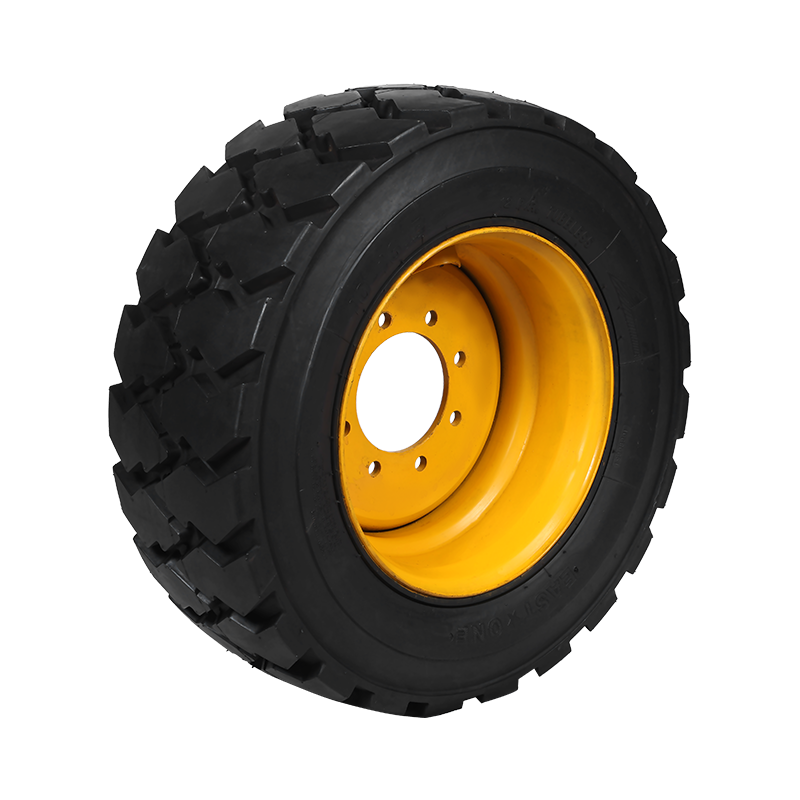
Foam-filled tires start life as standard pneumatic tires and are converted to solid configuration by injecting a two-component polyurethane foam through the valve stem after the tube or air charge is removed. The foam expands and cures inside the tire cavity, creating a solid fill that eliminates the air void and with it the puncture risk, while the pneumatic tire casing and tread pattern are retained. The result is a tire that looks and behaves much more like a pneumatic than a press-on solid — it has the same sidewall flexibility, a similar ride quality on rough surfaces, and retains the tread pattern geometry of the original pneumatic design. Foam-filled tires are particularly common on rough-terrain boom lifts and telehandlers where the machine was originally designed around pneumatic tire performance and where ride quality and surface traction on unprepared ground are important operational requirements.
The trade-off with foam filling is weight: a foam-filled tire is significantly heavier than its pneumatic equivalent, which adds to machine weight and affects its dynamic behavior. The foam fill also makes the tire non-repairable if the casing sustains damage — if the casing cuts or delaminates, the entire tire assembly must be replaced. Foam filling quality is highly dependent on the mix ratio and installation technique of the foam, and poorly filled tires can develop voids, uneven density, or delamination between the foam and casing that reduce their service life and compromise stability.
Reading Aerial Work Solid Tire Specifications
Tire specifications for aerial work platform solid tires are expressed in a standardized format that encodes the critical dimensional and load information needed to confirm compatibility with a specific machine. Misreading or ignoring these specifications is a common source of incorrect tire fitment, which can result in improper machine stability calculations, interference with machine structure, or inadequate load-carrying capacity.
The most commonly used size designation format for press-on and cushion solid tires is a three-number sequence such as 18×7-8 or 355×100-254. In the inch-based format (18×7-8), the first number is the overall tire diameter in inches, the second is the tire width in inches, and the third is the rim diameter in inches. In the millimeter format (355×100-254), the same three dimensions are expressed in millimeters. Both formats convey identical information — it is simply a matter of which measurement system the machine manufacturer uses. Always verify the rim diameter specified for your specific machine model before ordering, because a tire with the correct overall diameter and width but the wrong rim size will not press onto the wheel correctly and cannot be safely used.
Load capacity is the other critical specification. Every solid tire carries a rated load capacity — the maximum static or dynamic load it is designed to support — expressed in kilograms or pounds per tire. The load rating must match or exceed the maximum wheel load on the specific axle of the machine when fully loaded, including the platform load capacity and the weight of any attachments. Machine manufacturers publish wheel load data in their operator manuals, and this data should always be consulted when specifying replacement solid tires. Fitting a tire with an insufficient load rating is a safety violation and will result in accelerated wear, heat buildup, and potential tire failure under load.
Matching Solid Tire Compound to the Job Site Surface
Rubber compound selection is one of the most consequential and most frequently overlooked aspects of aerial work solid tire specification. The compound determines how the tire interacts with the surface it operates on — how much traction it generates, how quickly it wears, how much heat it builds up under continuous operation, and whether it leaves marks on sensitive flooring. A tire compound optimized for one application can perform poorly or cause operational problems in a different environment.
Standard Black Rubber Compound
Standard black rubber compound — the default material for the majority of aerial work platform solid tires — uses carbon black as the primary reinforcing filler. Carbon black significantly improves the mechanical properties of the rubber, particularly tensile strength, tear resistance, and abrasion resistance, but it is also what gives the tire its black color and its tendency to leave black scuff marks on light-colored flooring surfaces. Standard black compound tires are appropriate for outdoor construction sites, industrial facilities with concrete or asphalt surfaces where appearance is not a concern, and any application where wear resistance and load capacity are the primary requirements. They are the most cost-effective option and are available in the widest range of sizes.
Non-Marking White or Grey Compound
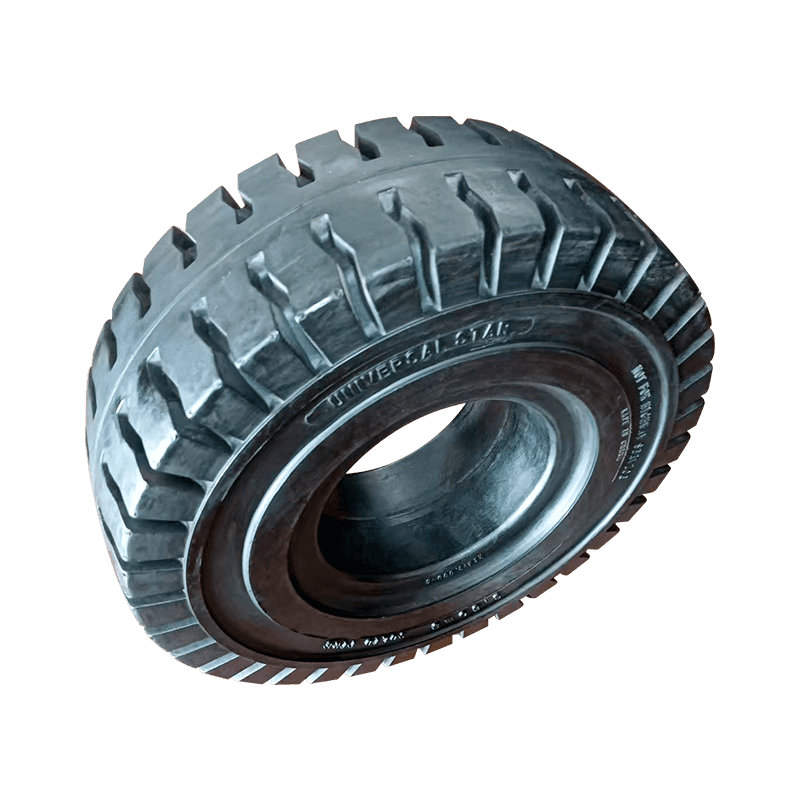
Non-marking solid tires for aerial work platforms replace carbon black with alternative reinforcing fillers — typically silica or light-colored mineral compounds — that deliver acceptable mechanical properties without the black pigmentation. The result is a tire in white, light grey, or pale buff color that does not leave visible rubber deposits on polished concrete, epoxy-coated floors, tiles, or other sensitive interior surfaces. Non-marking aerial work solid tires are specified for food production facilities, pharmaceutical manufacturing plants, logistics warehouses with finished floors, retail distribution centers, and any other environment where floor cleanliness and appearance are operationally or contractually important. They carry a modest price premium over equivalent black compound tires and may have slightly lower abrasion resistance in some formulations, but for indoor use on smooth surfaces this trade-off is entirely acceptable.
Anti-Static and Conductive Compound
In environments where electrostatic discharge poses a risk to sensitive electronics, explosive atmospheres, or sensitive manufacturing processes, aerial work platform solid tires formulated with anti-static or electrically conductive compounds are available. These tires are designed to dissipate static charge buildup from the machine to the floor, preventing the accumulation of charge on the platform and the operator that could discharge destructively. Anti-static solid tires must meet defined electrical resistance specifications — typically a surface resistance below 10⁸ ohms — and should be specified alongside other anti-static measures in the overall equipment grounding strategy for the facility. Standard black or non-marking compound tires are not substitutes for anti-static tires in genuinely at-risk environments, even if they appear similar externally.
Comparing Solid Tires to Pneumatic Tires on Aerial Work Platforms
Despite the strong case for solid tires on aerial work equipment, pneumatic tires retain genuine advantages in specific applications. Understanding the true comparative performance of each option across the dimensions that matter most in AWP operation helps fleet managers make the right tire specification decision for each machine and deployment context.
| Performance Factor | Aerial Work Solid Tires | Pneumatic Tires | Foam-Filled Tires |
| Puncture Risk | None | High on debris-laden sites | None |
| Ride Quality on Rough Ground | Moderate (cushion) to firm (press-on) | Best | Good |
| Maintenance Requirement | Very low — no pressure checks | Regular pressure monitoring required | Very low after filling |
| Floor Surface Compatibility | Excellent (non-marking options available) | Good but can damage soft surfaces | Good |
| Service Life | Long — no catastrophic failure mode | Variable — puncture or blowout risk | Long once installed correctly |
| Machine Stability on Slopes | Consistent — no deflection variation | Can vary with pressure changes | Consistent |
| Initial Cost | Low to moderate | Low | Moderate to high |
| Total Cost of Ownership | Low — minimal downtime and maintenance | Higher due to puncture and pressure costs | Low after initial investment |
How to Identify When Aerial Work Solid Tires Need Replacing
One of the practical advantages of solid tires on aerial work platforms is that they cannot go flat suddenly and leave a machine stranded mid-shift. However, solid tires do wear and degrade over time, and a worn solid tire on an aerial work platform is a genuine safety issue — not because of blowout risk, but because worn tires reduce load capacity, compromise traction, and in some designs allow the steel wheel rim to contact the floor surface, creating a rigid and unstable rolling base that increases tip-over risk.
Most press-on and cushion solid tires for aerial work platforms are manufactured with a wear indicator system — either a colored wear layer bonded beneath the outer tread compound, or a series of molded wear indicator holes or lines in the tread face. When the outer rubber wears down to expose the indicator color or reaches the indicator depth, the tire has reached the end of its serviceable life and must be replaced before the machine returns to service. Relying on visual indicator systems requires a disciplined pre-use inspection culture: operators and supervisors must actively check tire wear status as part of the daily machine inspection, not assume the tires are acceptable simply because the machine is running.
Beyond wear depth, the following conditions also indicate that aerial work solid tires require immediate replacement regardless of remaining tread depth:
- Chunking or tearing of the tread surface: Large pieces of rubber torn from the tread face indicate that the compound has degraded beyond its serviceable condition, either through age hardening, chemical exposure, or mechanical damage. A chunked tire has reduced contact area and unpredictable load distribution.
- Visible cracking in the sidewall or tread: Deep cracks — particularly those that penetrate more than a few millimeters — indicate ozone degradation or age-related hardening of the rubber compound. Cracked solid tires lose their elasticity and impact absorption capability and are prone to sudden section loss under load.
- Delamination of the press-on tire from the rim: If a press-on solid tire has worked loose on its rim — evidenced by lateral movement of the rubber relative to the wheel, or by a gap visible between the rubber bead and the rim groove — the tire must be re-pressed or replaced immediately. A delaminated press-on tire can separate from the rim suddenly under cornering or braking loads.
- Flat spots from prolonged stationary loading: Solid tires stored or left stationary under load for extended periods — particularly in cold environments — can develop permanent flat spots where the contact patch has taken a set. Flat-spotted solid tires create rhythmic vibration and uneven load distribution during operation and should be replaced.
- Age-related hardening beyond compound specification: Rubber compounds harden with age even without use, due to oxidation and ozone attack. Solid tires more than five to six years old — regardless of apparent tread depth or surface condition — should be assessed for hardness against the original compound specification and replaced if significantly harder than new, as aged hard compound provides inadequate cushioning and generates excessive floor contact stress.
Buying Aerial Work Solid Tires: What to Look For in a Supplier
The aerial work platform solid tire market includes a wide spectrum of product quality, from OEM-specification tires from major manufacturers to low-cost imports with inconsistent compound quality and dimensional accuracy. Purchasing decisions made purely on unit price without evaluating product quality and supplier capability frequently result in higher total cost — through shorter tire life, machine compatibility problems, and increased inspection labor — than a more considered approach would have delivered.
When evaluating solid tire suppliers for aerial work platform applications, the following factors deserve careful scrutiny beyond the headline price per tire:
- Dimensional consistency and tolerance documentation: A quality solid tire supplier should be able to provide dimensional control data — mean dimensions and tolerance spreads — for the specific size being purchased. Press-on solid tires that are even slightly undersized will not achieve the interference fit required for secure rim retention, while oversized tires may be impossible to press on without damaging the rim or the tire body.
- Load capacity certification: The load rating stated on the tire should be verifiable through a technical data sheet referencing the test standard used to establish it. Nominal load ratings printed on product listings without supporting test documentation should be treated with caution.
- Compound hardness specification: Reputable solid tire manufacturers publish the Shore A hardness specification of their tread compounds. This allows buyers to compare compound hardness between products and verify that the tire is appropriate for the surface type and operating conditions of the intended application.
- OEM approval or cross-reference listings: Suppliers who publish OEM cross-reference data — confirming which machine models their tires are designed to replace — provide useful independent confirmation of size and specification compatibility. This does not guarantee equivalent performance to the OEM product, but it confirms that the basic dimensional specification is aligned.
- Stock availability and supply consistency: For fleet operators managing multiple machines with high tire consumption, supplier reliability matters as much as product quality. A supplier who can commit to consistent stock availability, short lead times, and batch consistency across repeat orders reduces the operational risk of tire-related machine downtime.
Solid Tire Installation on Aerial Work Platforms: Getting It Right
Press-on solid tire installation requires proper hydraulic press equipment and the correct installation procedure to achieve the interference fit that holds the tire securely on the rim. Attempting to install press-on solid tires using improvised methods — heat, impact hammers, or vehicle weight — risks damaging both the tire and the rim and will not achieve the consistent seating required for safe operation.
The press force required to install a press-on solid tire varies with tire size and the interference fit designed into the tire-rim combination — typically in the range of 5 to 30 tonnes for scissor lift and boom lift tire sizes. The press must apply force evenly and concentrically across the full circumference of the tire bead to prevent tilting or partial engagement. Lubricating the rim and tire bead with a compatible lubricant — soapy water is widely used and effective — reduces the insertion force required and helps achieve full seating depth without damage. After pressing, the tire should be visually inspected around its full circumference to confirm even seating depth and the absence of gaps or misalignment between the tire and rim groove.
Foam-filled tire installation requires a different set of equipment and skills — a foam injection pump calibrated to deliver the correct mix ratio and fill volume for the specific tire cavity size, plus the time to allow the foam to cure fully before the machine is returned to service. Under-filling leaves voids that reduce load capacity and cause uneven rolling. Over-filling generates excess pressure within the casing that can cause sidewall bulging or bead separation. For fleet operators without in-house foam-filling capability, outsourcing this work to a specialist tire service provider with properly calibrated equipment is the lower-risk option compared to attempting it with rental or improvised equipment.

CONTACT US
-

Email: SMT001@saimeite-tyre.com
-

Phone: +86-18451337018No. 1, Renmin South Road, Yandu District, Yancheng City, Jiangsu Province, China